$100 Commander: CEDH On a Budget

What happens when Pauper players get hooked on cEDH ideas but refuse to spend cEDH money? Tony and I built a mini-format we call $100 Commander, high power, compact combos, and mana bases capped around $40.
This whole thing started because Tony and I fell in love with Pauper.
We liked the feeling of:
- Working inside a restriction
- Finding weird, powerful commons that overperformed
- Playing real Magic without spending a fortune
At some point we looked at each other and basically said:
“What if we did this for Commander? High power… but budget?”
That became our homebrew format:
$100 Commander – or as we think of it:
“cEDH on a budget.”
It’s not “casual jank.”
It’s powerful, tuned Commander lists with a hard price cap, using TCGPlayer Low to stay around $100.
- Think Pauper – constraint drives creativity
- Think budget Vintage – busted patterns, not busted price tags
- Think cEDH philosophy – tight builds, fast wins, lots of interaction
All with the challenge of $100 total, including a mana base that’s around $40 instead of several hundred dollars like a lot of fully powered cEDH decks.

What $100 Commander Is (And Isn’t)
Our working definition:
$100 Commander is competitive-leaning Commander where cost is capped, but power is not.
The goals:
- Play to win – real combo lines, real inevitability
- Play fast – low curves, efficient spells, clean interaction
- Play sharp – like cEDH, but inside a $100 deckbuilding puzzle
What it isn’t:
- “Precon plus a few upgrades”
- “I just jammed my binder into sleeves”
- “It’s budget so it’s low power”
We treat this like a format:
- We track prices using TCGPlayer Low
- We build with cEDH principles
- We accept that we can’t just auto-include the expensive staples
And in our version, some of the classic money cards (like Mana Crypt or Dockside Extortionist) are just off-limits by design. Not because they’re banned in official Commander, but because they blow up a $100 budget all by themselves and defeat the purpose of the exercise.
Why It Feels Like Pauper And Budget Vintage

The Pauper Connection
Pauper says: “Play only commons and see how far you can push it.”
What we loved about Pauper:
- The power is in synergy, not price
- Games feel fair but intense
- Deckbuilding becomes a puzzle, not just a shopping list
$100 Commander hits the same notes:
- You can play rares and mythics, but the total price ceiling matters
- You dig for the next-best version of staples instead of auto-slamming the most expensive option
- You discover bulk rares and uncommons that play way above their price tag
The Budget Vintage Energy
Budget Vintage says: “You can still do broken things, just not with an unlimited wallet.”
Likewise, $100 Commander:
- Still chases early wins or locked-up game states
- Still uses tutors, rituals, stax pieces, and compact combos
- Just does it while respecting that you’re not dropping hundreds of dollars on a mana base
That last bit matters.
The Mana Base Problem (And Why We Cap It)
In full cEDH, it’s totally normal for a mana base to be worth several hundred dollars on its own.
In $100 Commander:
- That doesn’t work.
- If we spent like that, the rest of the deck would be basic lands.
So a big part of how Tony and I think about this format:
Manage the mana base around $40 of the $100 budget.
That usually means:
- Basics, shocklands, painlands, and cheap duals
- A few utility lands only if they don’t wreck your curve
- Avoiding “flex lands” that enter tapped just because they’re cute
- Play mono-colored
If the average cEDH mana base is a luxury sports car, our mana bases are tuned hatchbacks with good tires.
Not flashy, but absolutely capable.

Step 1: Choose a Commander That Functions Like a cEDH Engine
Because we’re on a budget, the commander has to carry weight.
In $100 Commander, we look for commanders that are:
- Engines – they draw cards, make mana, or turn your deck into a value machine
- Combo pieces – they’re directly part of or enable a win line
- Or soft lock / stax pieces – they slow everyone else while you advance your plan
When we’re evaluating a potential commander, we ask:
- Does this commander reward cheap cards?
- Tokens, spells, sac fodder, looting, graveyard recursion, etc.
- Can it help close games, not just durdle?
- Triggers on cast, attack, or sacrifice that can snowball into a kill.
- Is it reasonably priced itself?
- If the commander is $25+, that’s a big chunk of the budget gone.
We want the commander to feel like the Pauper “build-around uncommon” meets cEDH engine.
Step 2: Build Like cEDH, Spend Like Pauper
The skeleton of our $100 lists looks very similar to cEDH:
- 30–32 lands (minimal taplands)
- 10–12 ramp pieces (rocks, dorks, rituals, land ramp)
- 10–14 interaction pieces (counters, removal, stack tricks)
- 1–3 compact win conditions / combo lines
- The rest: synergy and velocity
Differences from full cEDH:
- Your rocks are 2-mana rocks and cheap accelerants, not fast mana bombs
- Your interaction is efficient, but budget-friendly (no $50 “free” counters)
- Your lands are functional, not flex pieces that cost more than the rest of the deck combined
The philosophy stays the same:
- Low curve
- No wasted turns
- Never pass with mana unused if you can help it
- Every card should contribute to speed, interaction, or the win

Step 3: Combos Are Not Optional – They’re the Point
In casual EDH, a combo is a “spice slot.”
In $100 high-power Commander, combos are:
- Your way to keep up
- Your way to close games before value engines take over
- Your reward for tight play and deckbuilding
We like combos that:
- Use 2–3 cards
- Are supported by the deck’s natural game plan
- Have pieces that are totally fine on their own
Examples of the type of things we look for:
- A payoff that drains or damages when you sacrifice or create creatures
- A repeatable way to make tokens or recursion loops
- A free or cheap sacrifice outlet or untap effect
We’re not trying to copy-paste cEDH’s exact win lines card-for-card.
We’re trying to mirror the structure:
- Redundant lines
- Synergy between interaction and combo pieces
- The ability to pivot between aggression, stalling, and going for it

Step 4: Interaction Is Sacred
If we’re tuning a list and need to cut something, here’s our rule:
Cut the cute card before you cut the counterspell.
In a high-power meta, even on a budget, you must:
- Respect the stack
- Respect opposing combos
- Have answers to problem permanents
So we prioritize:
- 1–2 mana counterspells and protection effects
- Cheap spot removal for creatures, artifacts, and enchantments
- At least a couple of reset buttons (board wipes, pseudo-wipes, or one-sided blowouts)
Budget doesn’t mean “I just hope nobody does anything broken.”
Budget means “I found the $0.50 version of an answer that still hits what matters.”
Step 5: Using TCGPlayer Low As a “Format Rule”
To keep ourselves honest, we treat TCGPlayer Low like the official price list of the format.
Our process:
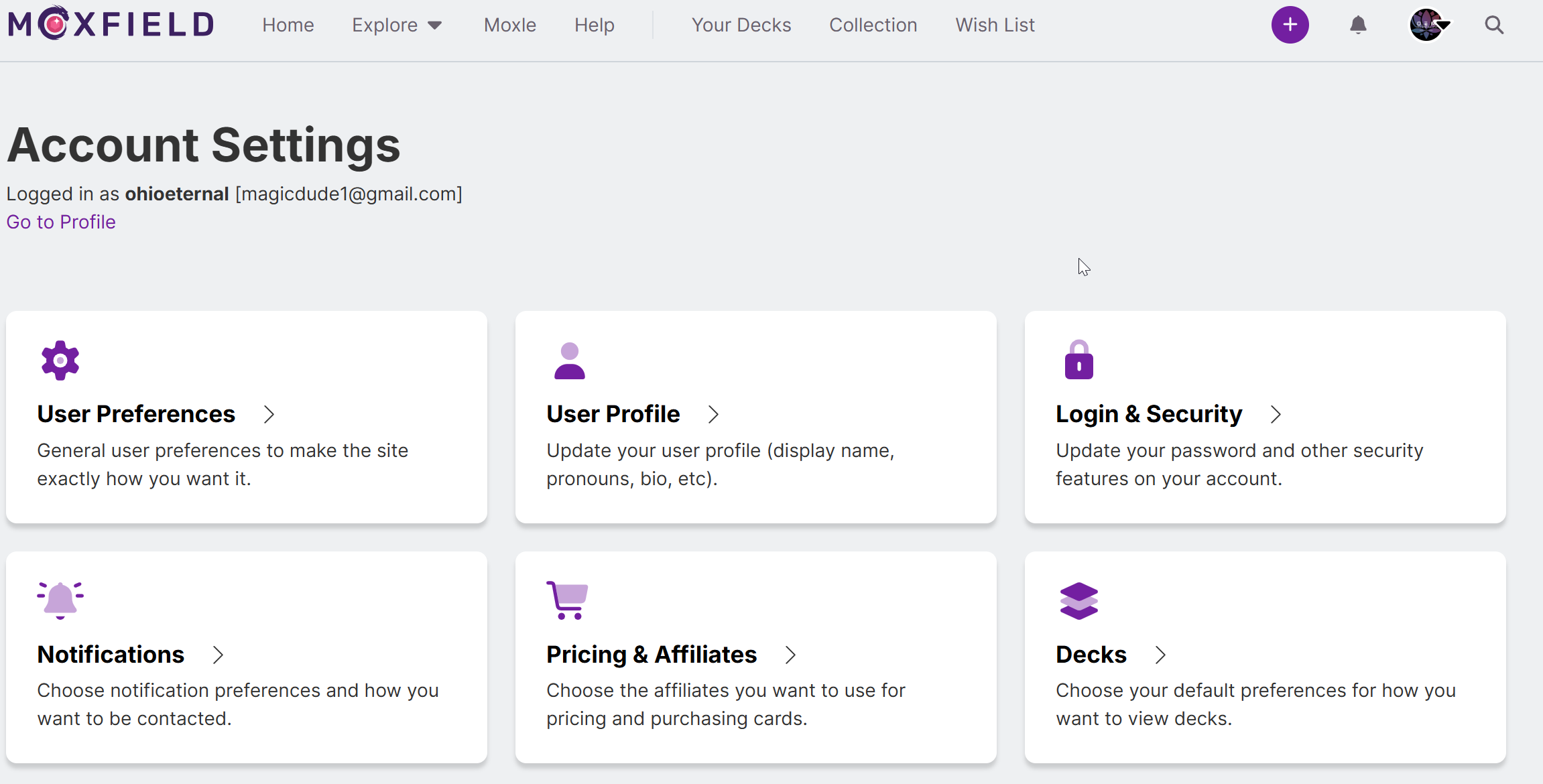
First, you need to go into your account settings and set the pricing to TCGPlayer.
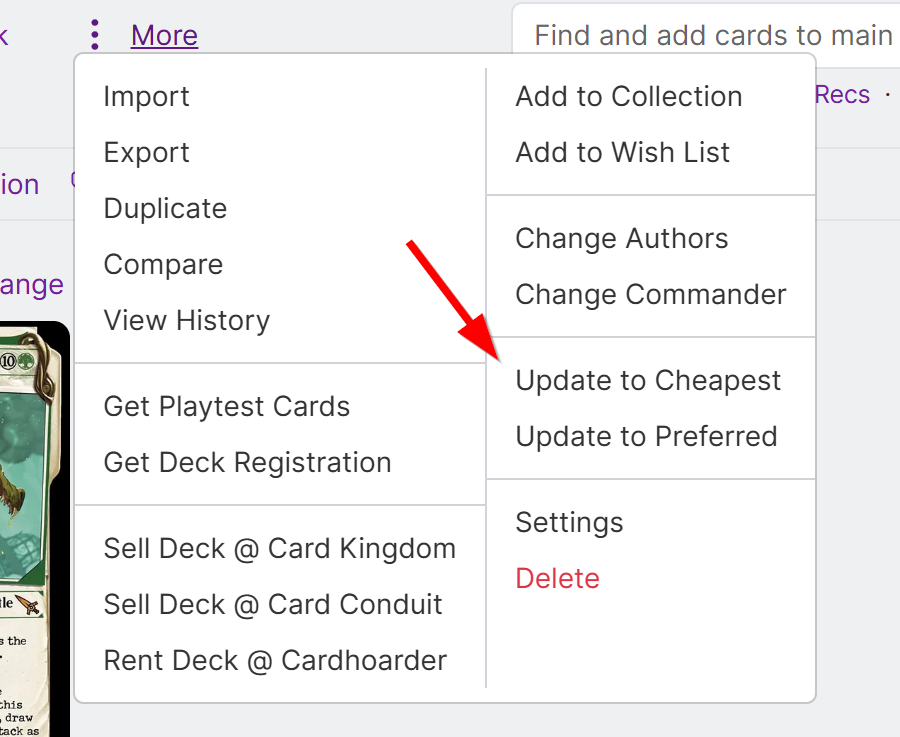
- Start off by building out your deck in Moxfield.
- Once you do that, click on the more options in moxfield and select "Update to Cheapest"
Once you do this, if you find that your deck is more expensive, I usually sort by price, look at the top 10–15 cards. From there I might make some adjustments to get the total price under $100.
Try to keep total around $100, with roughly $40 of that in lands.
Step 6: Setting Expectations With Your Group
If you sit down and say, “It’s a $100 deck,” people might assume it’s low power.
That’s not what we’re doing.
A better description is something like:
“This is a $100 budget cEDH-style deck. It’s built to be fast and interactive within that budget. It’s not precon power level.”
That helps:
- Casual players grab their more tuned decks
- Spikier players get excited instead of suspicious
- Groups start thinking, “Maybe we should all build one of these.”
Best-case scenario:
Your local group or friend circle ends up with a $100 Commander night, the same way Pauper nights started forming around shared constraints.
Step 7: Where You Go From Here
Once you’ve built one $100 Commander deck, you have two cool paths:
1. Stay in the $100 Ecosystem
- Maintain the deck as prices shift
- Tune it for your meta
- Build more $100 lists in different colors and archetypes
- Treat it like your own budget cEDH format
2. Use It As a Launch Pad to Full cEDH
- Keep the shell and reps you’ve built
- Slowly upgrade: mana base, tutors, interaction, then wincons
- Let the $100 version be your training wheels and testing lab
Either way, you’re not throwing money away.
You’re building skill, reps, and experience – the same way Pauper sharpened your limited/card evaluation skills.
Final Thoughts: High Power, Low Price, Real Magic
For us, $100 Commander started with a simple feeling:
“We love Pauper. We like the cEDH mindset. Let’s mash them together and see how far we can push it on a budget.”
The result is a format where:
- Decks are tight, fast, and interactive
- Combos and clean lines matter
- Money doesn’t decide who gets to play at the “high power” table
You don’t need a multi-hundred-dollar mana base to play powerful Commander.
You need:
- A smart commander choice
- Solid fundamentals
- A few spicy combo lines
- And a willingness to let the $100 cap be part of the fun, not a limitation.
If you are interested in the decks we have been putting together, you can check out our Moxfield here: https://moxfield.com/users/ohioeternal,


